Commercial · Cambridge
Commercial-Grade Lock Replacement
Overnight someone forced the back door, and the cylinder face is scarred, the metal around the strike has pulled loose from the frame, and the latch no longer sits flush.
Commercial-Grade Lock Replacement
In plain words
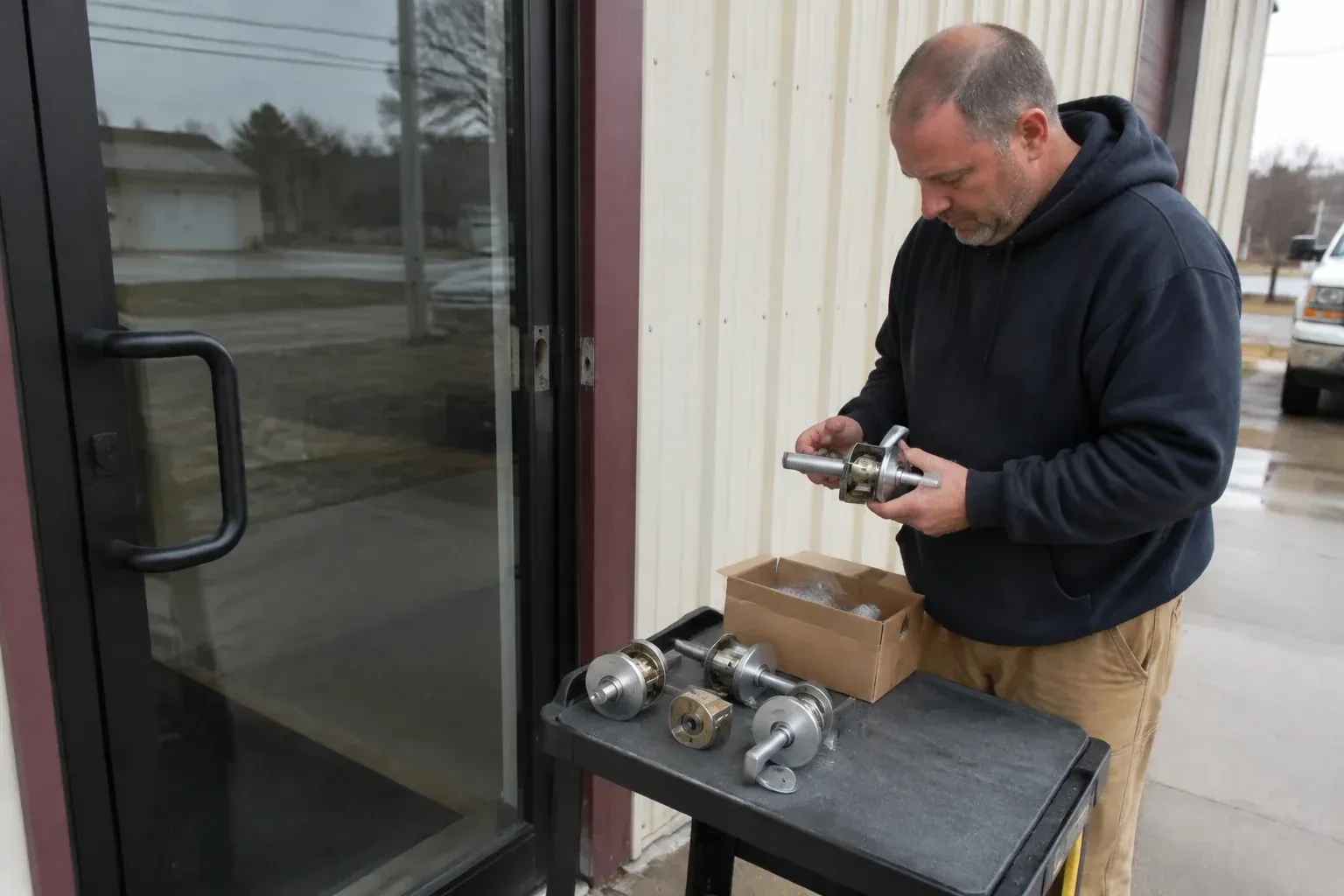
A business door rarely fails the same way a house door does, because it opens far more often and often has to satisfy a fire or egress rule a home door never faces. Replacement starts by identifying what the opening actually is: a mortise-prepped steel door, a narrow-stile aluminum storefront, a fire-rated door that needs listed hardware, or an exit serving enough people that code calls for panic-style release. The locksmith fits hardware built for that specific opening, connects it correctly to any electric strike or access-control wiring already present, and hands over keys cut and logged to the business's own system.
How the visit goesHead office wants every branch keyed alike under one system, and half the locations are still running whatever lockset the original contractor happened to install years ago.
Cambridge
How the visit goes
Finding what else is already wired to the door
Many commercial openings carry more than a mechanical lock: an electric strike, a maglock, a door position switch feeding an alarm panel, or a card reader tied to an access-control system. The locksmith identifies everything already connected to the opening before ordering replacement hardware, since a new lock has to coexist with that wiring rather than replace it by accident. Where the connected hardware is the actual source of the problem, that gets flagged separately rather than folded silently into a mechanical lock replacement.
Matching the cylinder to the business's key system
The cylinder installed is the one agreed during the assessment: keyed into an existing master or grand-master system, set up as a new interchangeable core the business can rekey itself later, or cut to a restricted keyway that limits who can order duplicate keys. Where several doors are being brought onto one system in the same visit, cylinders are combinated so a single key or a defined set of keys operates every door that is supposed to share access.
Confidence after a break-in or a security scare
Where the visit followed a forced door or a lost key that worried the business, the finished hardware answers that concern directly: the damaged cylinder or strike is gone, any compromised key no longer operates the cylinders that were rekeyed or replaced, and the new lock has been cycled and tested rather than simply swapped in and assumed to work. The business can tell staff, tenants or an insurer exactly what changed and why, with a working lock and a written record standing behind that answer rather than a guess about whether the problem was actually solved.
Commercial-Grade Lock Replacement
In the van
- Key cutting and coding machine
- Mortise prep and installation tools
- Electric strike
- Hookbolt and deadlatch hardware
- Strike plates and keepers
What affects the quote
Same fees day, night or weekend
1Fire-rated or listed hardware requirements
A door that is part of a fire separation needs hardware listed for that specific rating, which is a narrower and typically costlier category than general-purpose commercial hardware, and the quote reflects that requirement rather than a standard substitute.
2Keying complexity
A single stand-alone cylinder is the simplest keying job. A master or grand-master structure spanning multiple doors, departments or locations takes more planning and more cylinders to combinate correctly, and that planning is part of the quote.
3Type of hardware the door takes
A mortise lock body, a heavy cylindrical lockset and a narrow-stile lock or hookbolt are priced differently as hardware and take different amounts of labour to fit, so the quote follows what the door's own construction requires.
Commercial-Grade Lock Replacement: questions
Will replacing the lock affect my alarm or access-control system?
It can, if the door already carries a door position switch, an electric strike or a card reader, so the locksmith checks for that wiring before starting and reconnects and tests it alongside the new mechanical hardware. The goal is a door where the mechanical lock and the electronic system agree with each other rather than one working around the other.
What is the difference between a mortise lock and a cylindrical lockset?
A mortise lock has its whole mechanism, latch, deadbolt and sometimes a separate handle function, built into one case that sits inside a pocket cut into the door's edge. A cylindrical lockset is a bored-in unit, simpler to service, common on standard commercial and residential doors alike. Which one your door takes depends on how it was originally prepped, not on preference alone.
Do you replace hardware after an attempted break-in even if the door still locks?
Yes, and it is worth having it checked even when the door still appears to function. A cylinder that was drilled at, pried or struck can be weakened internally without showing it externally, and a bent strike or a cracked frame around the lock can let a door appear locked while offering far less resistance than it should.
Commercial Locks
- Master Key System DesignA new hire at the shop gets handed whatever spare key happens to be in the drawer, and it turns out…
- Access Control InstallationHead office wants a record of who opens the branch and when, tied to an actual name rather than a…
- Panic & Exit HardwareSomeone at the front counter always has to unlock the side door by hand before the lunch rush…
Commercial-Grade Lock Replacement near you
One team handles every service on this page for Cambridge, so a lockout can turn into a rekey, and a rekey into a properly set deadbolt, within the same visit if you want it. Each service is described separately below, but at the door they fit together as one piece of work.