Commercial · Cambridge
Commercial Rekeying in Cambridge
A key turned up in the parking lot with the shop's name on its fob. It came back to you, which is lucky, but it means keys are leaving the building on rings you have never seen, and the shop's locks have not changed since opening day.
Commercial Rekeying
In plain words
A business hands out keys as people join and rarely gets every one back as people leave. Rekeying resets that count. Instead of guessing how many copies of the front-door key exist, the cylinders are repinned so only the newly cut set works, and those keys are numbered and signed for. Where turnover is steady, the locksmith can fit interchangeable cores, which let a manager swap a core with a control key in a couple of minutes when someone departs, so the reset becomes routine rather than an event. Either way you end up with a premises where the keyholder list matches the staff list.
How the visit goesA key turned up in the parking lot with the shop's name on its fob. It came back to you, which is lucky, but it means keys are leaving the building on rings you have never seen, and the shop's locks have not changed since opening day.
Cambridge
How the visit goes
A walk of every door and lock
The locksmith walks the premises with you and lists every opening that should be in the plan: the customer entrance, the receiving door, offices, stockroom, cash room, server closet, the mailbox, cabinets, and any padlocks on gates, compounds or roll shutters. Each lock is identified by type, since a mortise cylinder in an aluminum storefront door, a key-in-lever set on an office, a rim cylinder on a back door and an interchangeable core in a stockroom each come out and go back in differently. The keyway and the maker's mark are noted, and the condition of each cylinder is checked, so the list from the walk is what the quote and the work are built on.
Swapping interchangeable cores
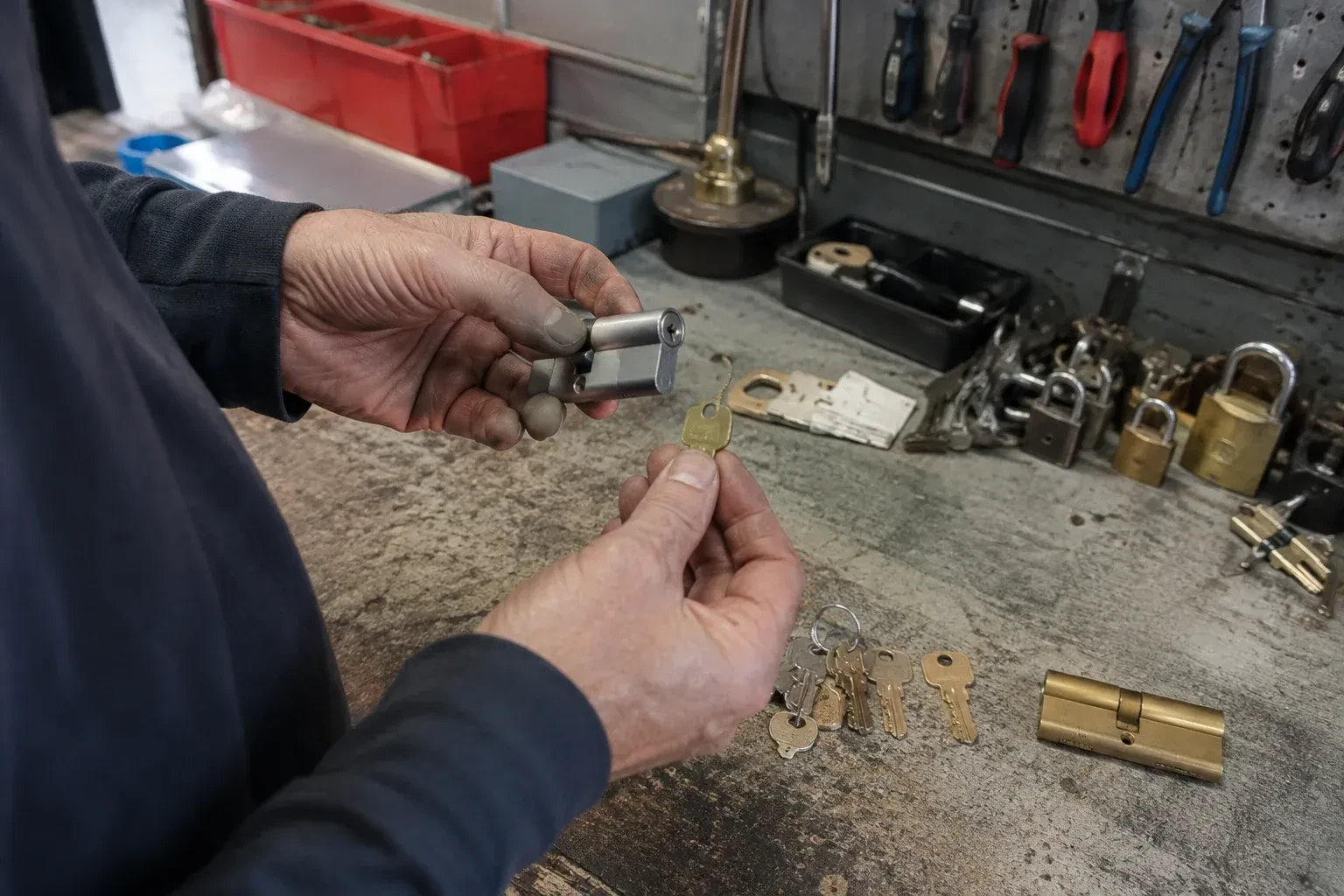
Where the business already runs on interchangeable cores, the door hardware never comes apart. The control key goes into the figure-eight core, turns a few degrees, and the whole core slides out of the lever or padlock in one piece. A freshly combinated core goes in the same way, the operating key is tried, and that door is done. The old cores travel back to the bench to be repinned for another opening or held as spares. This is what makes cores so well suited to businesses with steady turnover: a single control key, kept in the manager's safe rather than on a ring, is all it takes to change a lock.
A routine for the next departure
Turnover stops being a security event once there is a procedure for it. When someone leaves, their key is collected against the register and ticked off; if it cannot be produced, the chart shows exactly which cylinders that key opened, and only those are dealt with. Businesses that chose interchangeable cores can go further: the manager takes the control key from the safe, swaps the affected core for a spare in less time than a coffee break, and the locksmith repins the removed core at leisure for the next time. Either way the response is measured and specific, and the front door is never left answering to a key that walked out with a former employee.
Commercial Rekeying
In the van
- Dry graphite or PTFE lubricant
- Plug follower
- Standard and restricted key blanks
- Commercial pin kit
- Interchangeable cores and control key
What affects the quote
Same fees day, night or weekend
1Cylinders that need replacing
Where a worn, corroded or low-grade cylinder is better replaced than repinned, the new part is added for that door alone, and the locksmith points it out before the work begins.
2Restricted keyway
Moving to a patented, restricted keyway means new cylinders or cores rather than a repin of the old ones, and the blanks themselves carry a higher price than standard keys.
3How many keys are cut
Each key cut to code and stamped is counted into the quote. Two per door group for a small shop and forty for a warehouse shift are different numbers.
Commercial Rekeying: questions
What is the difference between rekeying a business and replacing its locks?
Rekeying keeps every lock on the door and changes only the pins inside the cylinder, so a new key works and the old ones stop. Replacing swaps the hardware itself. Commercial cylinders are made to be repinned many times, so rekeying suits any lock in sound condition and leaves the levers, trim and door untouched. Replacement is chosen door by door for cylinders that are worn, corroded or too light for what they protect.
Should we rekey every time an employee leaves?
Rekey when a key has not come back or when the departure was unfriendly; when a key is returned and the register confirms it, the cylinders it opened are as secure as before. Businesses that want a response to every departure without a visit each time fit interchangeable cores and swap them in-house. Whatever the trigger, dealing with only the cylinders that key opened keeps the response proportionate.
How long should we set aside for a commercial rekey?
It depends on the count and the mix. A shop with a front door, a back door and a stockroom is a short visit; an office suite with a dozen lever sets, a master key plan and a mailbox takes a good part of a day. Interchangeable cores are the shortest of all, since they are swapped rather than repinned on site. The locksmith gives a time estimate at the assessment, once every cylinder has been counted.
Commercial Locks
- Access Control InstallationHead office wants a record of who opens the branch and when, tied to an actual name rather than a…
- Panic & Exit HardwareSomeone at the front counter always has to unlock the side door by hand before the lunch rush…
- Commercial-Grade Lock ReplacementOvernight someone forced the back door, and the cylinder face is scarred, the metal around the…
Commercial Rekeying near you
One team handles every service on this page for Cambridge, so a lockout can turn into a rekey, and a rekey into a properly set deadbolt, within the same visit if you want it. Each service is described separately below, but at the door they fit together as one piece of work.